
Dental Implants in Pine Beach, NJ

What a Dental Implant Replaces
An implant rebuilds a tooth from the root up. That matters, because the root is the part that keeps your jawbone working, and the part no other replacement can stand in for.
One missing tooth
A single implant fills the gap on its own. The healthy teeth on either side are left exactly as they are, with nothing reshaped to hold a replacement in place.
Several teeth in a row
Two well-placed implants can carry a fixed bridge across a longer span, so you are not adding hardware to every tooth in the run.
A full arch
For patients who have lost most or all of the teeth in one jaw, a set of implants placed across the arch can anchor a full restoration that does not come out at night.
A denture that moves
If a lower denture lifts when you eat or speak, implants can be used as anchor points so it clips into position instead of resting on the gum.
A tooth that cannot be saved
When a tooth has fractured below the gumline or decay has gone too far to restore, the implant is usually planned at the same time as the removal, not months afterwards.

Bone that has started to shrink
The jaw slowly thins where a root used to be. An implant post takes over that stimulating job, which is why the timing of the conversation matters as much as the treatment.
If the tooth can still be saved, we will tell you so. Rebuilding a cracked but healthy tooth with a dental crown is almost always the better outcome, and a dental bridge still suits some situations well. Where a tooth genuinely has to go, we plan the extraction and what follows it as one piece of work.
How Implant Treatment Works Here
Implant treatment is a handful of short appointments spread across several months. Most of that time is spent healing rather than sitting in the chair.
What the timeline actually looks like
Dr. Mariya Medlenov walks through every stage before anything begins, including what happens at each visit and how long the gap between them is likely to be. Nothing is rushed. Bone heals at its own pace, and we take it slowly on purpose so that each stage is stable before the next one starts.

Consultation and imaging. We look at the gap, the neighbouring teeth, your gum health and the bone underneath, using a 3D CBCT scan rather than guesswork.
Preparation, when it is needed. Some patients need a tooth removed first, or the bone built back up. That stage heals on its own schedule before anything is placed.
Placing the post. The titanium post is placed into the jaw under local anaesthetic. Most patients find this appointment quieter than they had braced for, and we talk through comfort options beforehand.
Healing. Over the following months the bone grows tightly around the post. You wear a temporary tooth through this stage and carry on with normal life.
The final tooth. A custom crown is shaded to the teeth around it and fitted onto the post. This is the visit where it stops feeling like a project and starts feeling like your tooth.
Coverage differs from plan to plan, so we review what yours includes before treatment starts and set out the sequence and the estimate in writing. Our financial options page explains how we handle that side of things.
Why We Scan Before We Place
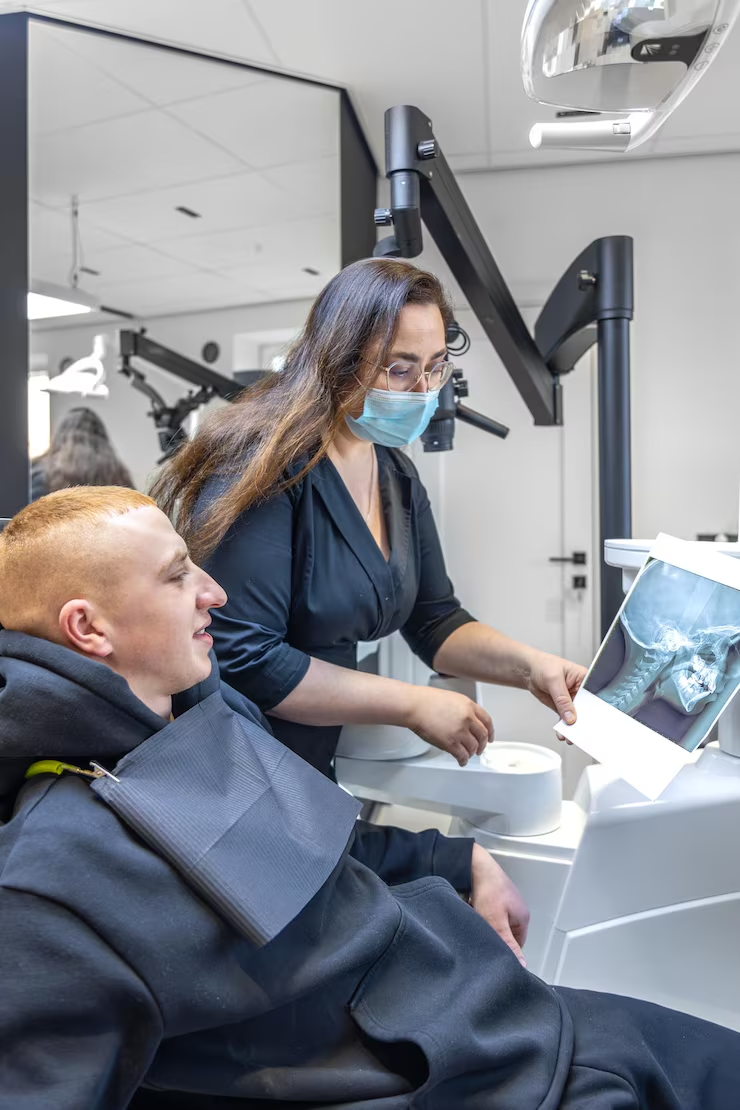
The bone decides the plan
You cannot judge bone from the outside, and a flat x-ray only tells part of the story. A three-dimensional scan shows how much height and width of bone is actually there, where the nerve runs, and how close the sinus sits. That is what decides whether an implant can be placed as things stand, or whether the site needs building up first.
Depth and width. The scan measures bone in three dimensions instead of the flat outline a standard image gives, so the post length is chosen rather than estimated.
Nerve position. In the lower jaw, knowing exactly where the nerve runs is what keeps placement safe and predictable.
Gum health first. Implants sit in gum tissue, so active gum disease is treated and settled before one goes anywhere near it. That is periodontal care, and it comes first for a reason.
A plan you can look at. We put the scan on the screen and walk through it with you, so the recommendation is something you can see for yourself rather than something you have to take on trust.
Is an Implant the Right Choice for You?
Implants suit a lot of people, but not everybody, and not always straight away. Here is how we think about it.
Who tends to do well with implants
Adults in reasonable general health, with healthy gums and enough bone to hold a post, are usually straightforward candidates. Good day-to-day brushing and flossing matters more than age. Plenty of our implant patients are in their seventies and eighties. What we look for is a mouth that is stable, a gum line that is not inflamed, and a willingness to come back for the routine checks that keep the implant in good order once it is in.
When we suggest waiting, or suggest something else
If gum disease is active, it gets treated first. If bone has thinned in the area, grafting may be needed before placement, which adds months to the plan rather than ruling it out. Smoking slows healing, and we will talk honestly with you about what that means for your case. Some patients are better served by a fixed bridge, and for others a well-made set of dentures is the more sensible answer for now. Recommending the treatment that fits your mouth is more useful than recommending the most involved one.
Looking after an implant once it is in
An implant crown does not decay, but the gum and bone holding it can still get sick if plaque is left to build around it. Brush it like a natural tooth, clean between and around it daily, and keep your routine checkups. Implants are designed to last many years, and the ones that do are almost always the ones that get looked after and reviewed regularly.
Where our implant patients come from
Century Dental East is on Washington Avenue in Pine Beach, and we see implant patients from Toms River, Bayville, Beachwood, Berkeley Township, Ocean Gate, Forked River, Waretown and across Ocean County. Because implant treatment runs over several visits, being able to get to the office easily makes a real difference. You can read more about Dr. Mariya Medlenov and the team, or get in touch with a question before you commit to anything.
Talk to us about dental implants in Ocean County
If you are living with a gap, a failing tooth or a denture that will not stay put, the first step is a conversation and a scan. Call Century Dental East at (732) 341-6010 or contact our Pine Beach office to arrange a consultation with Dr. Mariya Medlenov.
Visit Our Pine Beach Office
Century Dental East — Gentle, Modern Dentistry for Families in Pine Beach, NJ.
241 Washington Avenue, Pine Beach, NJ 08741
(732) 341-6010


Hours
Mon 9:00 a.m. – 6:00 p.m.
Tue 9:00 a.m. – 7:00 p.m.
Wed 9:00 a.m. – 5:00 p.m.
Thu 9:00 a.m. – 5:00 p.m.
Fri-Sun Closed
Serving patients across
- Toms River
- Lakewood
- Lakehurst
- Forked River
- Bayville
- Beachwood
- Pine Beach
- Barnegat Light
- Ocean Gate
- Maple Shade
- Leisure Village
- Cedar Grove
- Waretown
- Howardsville
- Brookville
- Holly Park
- South Toms River